

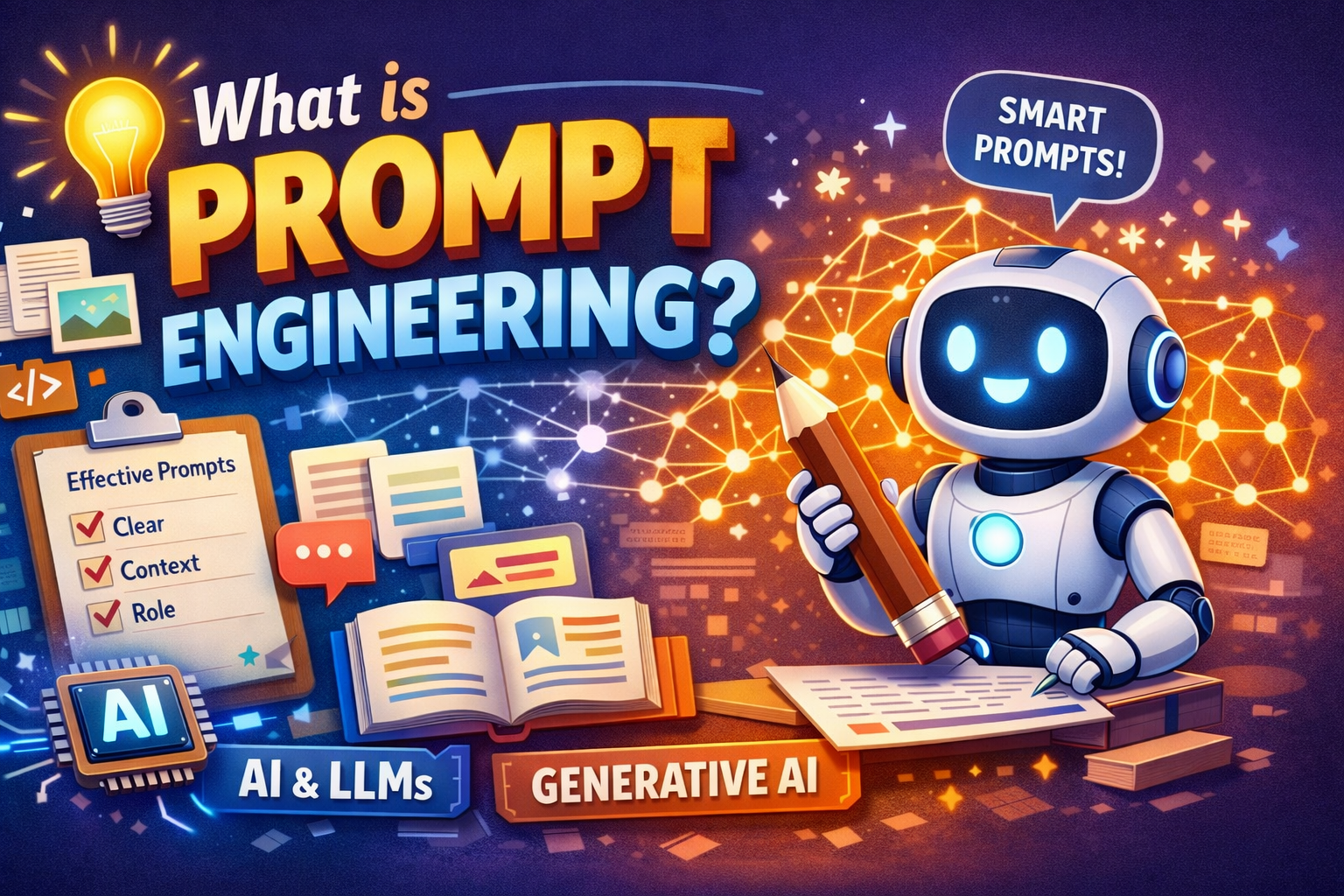
What Is Prompt Engineering? A Simple Guide for Beginners
Artificial Intelligence (AI) is changing how we work, learn, and create content. From writing stories to generating images and answering questions, AI tools are everywhere. But have you ever wondered how AI knows what to do when you ask it something?
That’s where prompt engineering comes in.
In this blog, we will explain what prompt engineering is, why it is important, and how anyone—even beginners—can learn it. No technical jargon, no confusion. Just simple words and real examples.
What Is Prompt Engineering?
What is prompt engineering?
Prompt engineering is the skill of writing clear instructions (prompts) to get the best answers from an AI model.
A prompt is what you type or say to an AI tool.
For example:
“Write a story about a lion.”
“Explain gravity in simple words.”
“Create a YouTube video script.”
Prompt engineering means learning how to ask questions in a smart way so AI understands exactly what you want.
Think of AI like a very smart robot child. If you give clear instructions, you get a great result. If your instructions are confusing, the result will also be confusing.
What Is Prompt Engineering in AI?
What is prompt engineering in AI?
In AI, prompt engineering is the process of designing and improving prompts so that AI systems give useful and high-quality responses.
AI does not “think” like humans. It works based on:
Patterns
Data
Instructions you provide
So the quality of the output depends heavily on the quality of your prompt.
Example:
❌ Bad prompt:
“Write about dogs.”
✅ Good prompt:
“Write a 200-word story about a friendly dog for kids, using simple language.”
Same AI, different results. That’s the power of prompt engineering.
What Is Prompt Engineering in Generative AI?
What is prompt engineering in generative AI?
Generative AI is a type of AI that creates new content, such as:
Text (articles, stories, scripts)
Images
Music
Code
Videos (with tools)
Examples of generative AI tools:
ChatGPT
Gemini
Midjourney
DALL·E
Prompt engineering in generative AI means guiding the AI to generate what you need, not random content.
Example (Generative AI):
Prompt:
“Create a motivational quote for students who feel stressed before exams.”
The AI generates new text, not copied from anywhere. Your prompt decides:
Tone (motivational)
Audience (students)
Situation (exam stress)
What Is Prompt Engineering in the Context of LLM?
What is prompt engineering in the context of LLM?
LLM stands for Large Language Model. These are powerful AI models trained on large amounts of text.
Examples of LLMs:
GPT models
Claude
LLaMA
In the context of LLMs, prompt engineering means:
Structuring prompts clearly
Giving context
Setting rules
Defining output format
LLMs follow instructions very well, but only if they are clear.
Example (LLM Context):
Prompt:
“Act as a science teacher. Explain photosynthesis in simple words for a 5th grader. Use bullet points.”

Here, you told the LLM:
Role (science teacher)
Topic (photosynthesis)
Level (5th grade)
Format (bullet points)
That’s professional prompt engineering.
Why Is Prompt Engineering Important?
Prompt engineering matters because:
Better results: Clear prompts = better answers.
Saves time: No need to ask the same question repeatedly.
Improves accuracy: You reduce wrong or useless answers.
Boosts productivity: Writers, developers, students, marketers—all benefit.
Future-proof skill: AI is growing fast. Prompt engineering is becoming essential.
Let’s be honest: AI is not replacing people. People who know how to use AI properly are replacing those who don’t.
What Is Prompt Engineering and How to Learn It?
Now the big question: What is prompt engineering and how to learn it?
Good news—you don’t need:
A computer science degree
Advanced math
Coding knowledge
You just need practice and logic.
Step 1: Learn to Be Clear
Always tell AI:
What you want
Who it is for
How long it should be
Style or tone
Example:
“Write a 500-word blog explaining climate change for beginners using simple English.”
Step 2: Give Context
Context helps AI understand the situation.
Instead of:
“Write an ad.”
Try:
“Write a Facebook ad for a local gym targeting beginners who want to lose weight.”
Step 3: Use Roles
Assigning a role improves results.
Examples:
“Act as a teacher.”
“Act as a digital marketing expert.”
“Act as a YouTube scriptwriter.”
AI performs better when it knows who it is supposed to be.
Step 4: Ask for Format
Tell AI how you want the output.
Examples:
Bullet points
Table
Step-by-step guide
Short paragraphs
Example:
“Explain prompt engineering in 5 bullet points.”
Step 5: Practice Daily
Prompt engineering is a skill, not magic.
Practice by:
Rewriting prompts
Testing different styles
Improving weak answers
The more you practice, the smarter your prompts become.
Common Mistakes in Prompt Engineering
Avoid these beginner mistakes:
❌ Being too vague
❌ Giving no context
❌ Expecting AI to read your mind
❌ Writing one-line prompts for complex tasks

Remember: Garbage prompt equals garbage output.
Real-World Uses of Prompt Engineering
Prompt engineering is already used in:
Content writing (blogs, scripts, ads)
YouTube automation
Education
Customer support chatbots
Programming
Game development
If you use AI for work, prompt engineering directly affects your results and income.
Is Prompt Engineering a Good Career?
- AI prompt specialists
- AI content strategists
- Automation experts
Even freelancers who understand prompt engineering:
- Work faster
- Deliver better quality
- Earn more money
This skill is still emerging. Learning it now gives you a big advantage.
Final Thoughts
So, what is prompt engineering?
It is the art of communicating with AI effectively.
Whether you are a:
- Student
- Content creator
- Developer
- Marketer
- Beginner
Prompt engineering helps you control AI instead of guessing.
The truth is simple: AI is powerful, but only if you know how to guide it.
Start small. Practice daily.
This skill will matter a lot in the
sulavrapal.com.np